
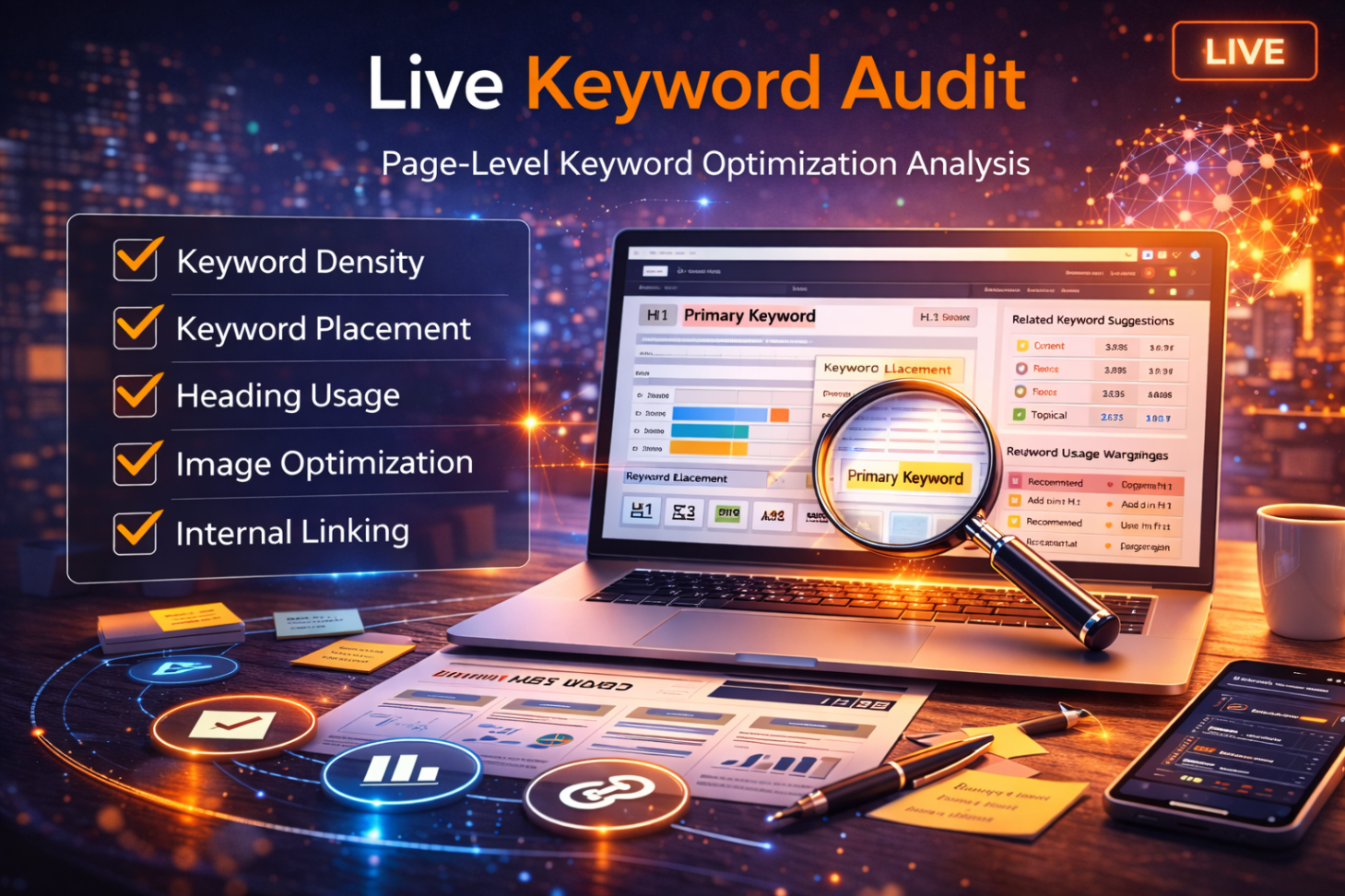
Live Keyword Audit: Analyze Keyword Density, Placement & Page Alignment
Understanding how keywords appear and function on a webpage is essential for strong search visibility. Even when a page targets the right keywords, improper placement, weak supporting terms, or poor content structure can prevent it from ranking effectively.
The Live Keyword Audit Tool inside My PR Manager analyzes how keywords are used across a page, helping businesses strengthen on-page SEO signals and improve content alignment with search intent.
💡 Quick Answer
A keyword audit analyzes how a target keyword appears across a webpage, including its placement in headings, content frequency, internal links, image tags, and supporting keyword context. This helps ensure a page is properly optimized for both search engines and AI-driven discovery systems.
ℹ️ What this means
Search engines do not simply look for keywords—they evaluate how keywords are structured within a page. Proper keyword placement and supporting terms help search engines understand the topic and relevance of your content.
What the Live Keyword Audit Tool Does
The Live Keyword Audit Tool scans a webpage and evaluates how well its content aligns with a chosen keyword.
The audit reviews several on-page optimization signals, including:
-
keyword density within the content
-
keyword placement within headings
-
usage within title tags and metadata
-
keyword presence in image alt attributes
-
internal linking relevance
-
use of supporting and related keywords
⚡ SEO Insight
Search engines evaluate keyword context, not just frequency. Pages that include well-structured keyword signals and related topic terms tend to perform better in both traditional search and AI-generated search responses.
Key Keyword Optimization Signals Analyzed
Keyword Placement Within Headings
Headings help search engines understand the structure of a page and the importance of specific topics.
The audit checks whether the target keyword appears within:
-
H1 headings
-
H2 and H3 subheadings
-
structured content sections
ℹ️ What this means
Proper keyword placement within headings helps search engines quickly understand what a page is about.
Keyword Density and Content Balance
Keyword density measures how often a keyword appears relative to the total content on the page.
The Live Keyword Audit evaluates:
-
keyword frequency
-
keyword balance within the content
-
potential keyword overuse or underuse
⚡ SEO Insight
Modern SEO focuses on natural language usage, not keyword repetition. Balanced keyword placement combined with supporting phrases helps search engines better interpret the topic.
Image Alt Tags and Media Signals
Images contribute additional contextual signals when they include descriptive alt attributes.
The audit checks:
-
keyword usage in image alt text
-
descriptive media signals supporting the page topic
ℹ️ What this means
Search engines analyze image alt text to better understand page content and improve accessibility signals.
Internal Linking and Topic Support
Internal links help reinforce keyword topics by connecting related pages.
The Live Keyword Audit evaluates:
-
internal link placement
-
anchor text relevance
-
topic relationship between pages
⚡ SEO Insight
Pages that are strongly connected through internal linking tend to perform better in search rankings because they create clearer topic relationships.
How This Tool Fits Into the My PR Manager Workflow
The Live Keyword Audit Tool plays an important role within the My PR Manager SEO workflow, helping businesses refine content optimization after identifying target keywords.
Typical workflow:
Keyword Research Tool
→ https://myprmanager.com/blog/36/keyword-research-tool-for-seo-ai-search-my-pr-manager
Live Keyword Audit
→ analyze keyword placement and page alignment
AI Article Publishing & Blog Scheduler
→ https://myprmanager.com/blog/33/ai-article-publishing-blog-scheduler-for-seo-my-pr-manager
AI Article Rewriter Tool
→ https://myprmanager.com/blog/56/ai-article-rewriter-tool-for-seo-content-optimization-my-pr-manager
Daily Keyword Ranking Tracker
→ https://myprmanager.com/blog/43/daily-keyword-ranking-tracker-for-google-seo-my-pr-manager
💡 Quick Answer
Keyword research identifies opportunities, keyword audits optimize page structure, publishing tools create content, and ranking trackers monitor performance.
Benefits of Running a Keyword Audit
Using the Live Keyword Audit Tool helps businesses:
-
Improve on-page keyword alignment
-
Identify missing keyword placement opportunities
-
Strengthen heading structure and content clarity
-
Optimize internal linking relationships
-
Improve search engine topic interpretation
ℹ️ What this means
Strong keyword alignment improves the ability of search engines and AI systems to interpret the topic and relevance of your content.
Key Takeaways
-
Keyword placement affects how search engines interpret page topics
-
Heading structure plays a major role in on-page optimization
-
Supporting keywords strengthen semantic relevance
-
Internal linking reinforces topical authority
-
Balanced keyword usage improves SEO and AI visibility
Conclusion
Keyword research helps identify valuable search opportunities, but proper keyword implementation is what ultimately determines whether a page performs well in search results.
The Live Keyword Audit Tool inside My PR Manager provides a clear analysis of keyword placement, content structure, and internal linking signals that influence search visibility. When combined with keyword research, content publishing, and ranking tracking tools, businesses can create a complete SEO workflow that strengthens both traditional search rankings and AI-powered discovery.
Frequently Asked Questions
What is a keyword audit?
A keyword audit evaluates how a keyword is used within a webpage, including placement within headings, content frequency, image alt text, and internal linking structure.
Why is keyword placement important for SEO?
Search engines analyze keyword placement within headings and structured content to understand the main topic of a page.
How often should a keyword audit be performed?
Keyword audits should be performed when publishing new content, updating older pages, or optimizing pages that are not performing well in search rankings.
Does keyword optimization help AI search systems?
Yes. AI systems rely on structured content and contextual keyword signals to interpret and summarize web pages accurately.